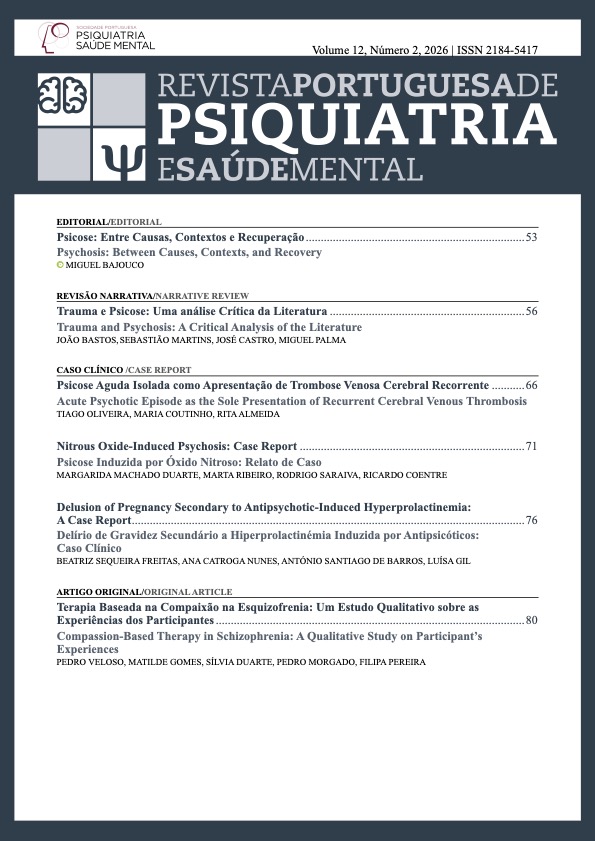
Compassion-Based Therapy in Schizophrenia: A Qualitative Study on Participant’s Experiences
DOI:
https://doi.org/10.51338/rppsm.681Keywords:
Empathy, Mindfulness, Psychotherapy, Schizophrenia/therapy, Schizophrenic Psychology, Self ConceptAbstract
Introduction: Schizophrenia is associated with psychological distress, functional impairments, and reduced quality of life. Compassion-based therapies, such as the Compassionate Approach to Schizophrenia and Schizoaffective Disorder (COMPASS) program, have been proposed as complementary interventions to promote psychosocial recovery. This study explored the experiences of individuals with schizophrenia who participated in the COMPASS program, assessing its feasibility, acceptability, and perceived impact on emotional well-being, clinical symptoms, functioning, social relationships, and quality of life.
Methods: An intervention study with qualitative analysis was conducted. Sixteen outpatients with schizophrenia were invited to participate, of whom nine completed the program. Sessions combined psychoeducation, compassionate mind training, and mindfulness practices. After the intervention, participants were interviewed using a semi-structured guide focused on their overall experience and perceived impact regarding the therapy. Interviews were audio-recorded, transcribed, and analyzed through thematic analysis. Attendance and dropout rates complemented the feasibility assessment.
Results: The dropout rate was 43.8%, occurring mainly during the first few weeks. Among the nine participants who completed the program, mean attendance was high (91.7%). Thematic analysis identified six main themes: (1) well-being and emotional regulation, (2) impact on schizophrenia symptoms, (3) impact on social relationships, (4) functional changes and quality of life, (5) valued aspects of therapy, and (6) overall experience of participation. Most participants reported greater calmness, reduced anxiety, increased compassion, and improvements in relationships and quality of life. Two participants described reductions in auditory hallucinations and paranoid ideas. The group format, psychoeducation, and experiential practices were highlighted as valued components. Main difficulties included initial anxiety, concentration difficulties, and asymmetry in participation. Participants’ suggestions regarding the intervention were also explored.
Conclusion: The findings suggest that the COMPASS program is a promising complementary intervention for psychosocial recovery in schizophrenia, with high acceptability. The program appears to promote emotional well-being, improve relational skills and quality of life, and, to a lesser extent, reduce psychotic symptoms. Further studies are needed to clarify the program’s efficacy and optimize its implementation.
Downloads
References
American Psychiatric Association. Diagnostic and statistical manual of mental disorders. 5th ed. Washington: American Psychiatric Association Publishing; 2013.
World Health Organization. International classification of diseases, 11th revision (ICD-11); 2025. [Accessed: October 1st, 2025] Available at: https://icd.who.int/
Jauhar S, Johnstone M, McKenna PJ. Schizophrenia. Lancet. 2022;399:473-86. doi:10.1016/ S0140-6736(21)01730-X
Dong M, Lu L, Zhang L, Zhang YS, Ng CH, Ungvari GS, et al. Quality of Life in Schizophrenia: A Meta-Analysis of Comparative Studies. Psychiatr Q. 2019;90:519-32. doi:10.1007/s11126-019-09633-4
National Institute for Health and Care Excellence (NICE). Psychosis and schizophrenia in adults: prevention and management. NICE Clinical Guidelines, No. 178; 2014. [Accessed October 1st, 2025] Available at: https://www.ncbi.nlm.nih.gov/books/NBK555203/
Haddad PM, Correll CU. The acute efficacy of antipsychotics in schizophrenia: a review of recent meta-analyses. Ther Adv Psychopharmacol. 2018;8:303-18. doi:10.1177/2045125318781475
Lawlor C, Sharma B, Khondoker M, Peters E, Kuipers E, Johns L. Service user satisfaction with cognitive behavioural therapy for psychosis: Associations with therapy outcomes and perceptions of the therapist. Br J Clin Psychol. 2017;56:84-102. doi:10.1111/bjc.12122
Gomes M, Fernandes N. Terapias de terceira geração nas perturbações psicóticas. Rev Port Psiquiatria Saúde Mental. 2021;7:58-65. doi:10.51338/rppsm.319
Gilbert P. The origins and nature of compassion focused therapy. Br J Clin Psychol. 2014;53:6-41. doi:10.1111/bjc.12043
Gumley A, Braehler C, Laithwaite H, MacBeth A, Gilbert P. A compassion focused model of recovery after psychosis. Int J Cogn Ther. 2010;3:186-201. doi:10.1521/ijct.2010.3.2.186
Martins MJ, Macedo A, Carvalho CB, Pereira AT, Castillo P. Are shame and self-criticism the path to the pervasive effect of social stress reactivity on social functioning in psychosis?. Clin Psychol Psychother. 2020;2752-60. doi:10.1002/cpp.2406
Gerlinger G, Hauser M, De Hert M, Lacluyse K, Wampers M, Correll CU. Personal stigma in schizophrenia spectrum disorders: a systematic review of prevalence rates, correlates, impact and interventions. World Psychiatry. 2013;12:155-64. doi:10.1002/wps.20040
Kesting ML, Lincoln TM. The relevance of self-esteem and self-schemas to persecutory delusions: a systematic review. Compr Psychiatry. 2013;54:766-89. doi:10.1016/j.comppsych.2013.03.002
Lincoln TM, Mehl S, Kesting ML, Rief W. Negative symptoms and social cognition: identifying targets for psychological interventions. Schizophr Bull. 2011;37:S23-S32. doi:10.1093/schbul/sbr066
Löw CA, Schauenburg H, Dinger U. Self-criticism and psychotherapy outcome: A systematic review and meta-analysis. Clin Psychol Rev. 2020;75:101808. doi:10.1016/j.cpr.2019.101808
Mavituna S, Hahn E, Hahne I, Bergmann N, Pijnenberg M, Ta T, et al. Compassion-based approaches: a systematic review of their effectiveness and acceptability in schizophrenia spectrum disorders. Curr Psychol. 2023;42:16868-82. doi:10.1007/s12144-022-02908-3
Garrett C, Smith DM, Wittkowski A. The acceptability of compassion-focused therapy in clinical populations: a metasynthesis of the qualitative literature. Front Psychiatry. 2025;16:1400962. doi:10.3389/fpsyt.2025.1400962
Martins MJ, Barreto Carvalho C, Macedo A, Pereira AT, Braehler C, Gumley A, et al. Recovery through affiliation: A compassionate approach to schizophrenia and schizoaffective disorder (COMPASS). J Contextual Behav Sci. 2018;9:97-102. doi:10.1016/j.jcbs.2018.07.009
Martins M, Castillo P, Barreto Carvalho C, Pereira A, Braehler C, Macedo A. Mindfulness e Compaixão na recuperação da psicose. Lisboa: Pastor; 2020.
Gilbert P, Irons C. Focused therapies and compassionate mind training for shame and self-attacking. In: Gilbert P, editor. Compassion: Conceptualisations, research and use in psychotherapy. London: Routledge; 2005. p. 263-325.
Chadwick P. Mindfulness for psychosis. Br J Psychiatry. 2014;204:333-4. doi:10.1192/bjp.bp.113.136044
Shonin E, Van Gordon W, Griffiths MD. Do mindfulness-based therapies have a role in the treatment of psychosis?. Aust N Z J Psychiatry. 2014;48:124-7. doi:10.1177/0004867413512688
Skivington K, Matthews L, Simpson SA, Craig P, Baird J, Blazeby JM, et al. A new framework for developing and evaluating complex interventions: update of Medical Research Council guidance. BMJ. 2021;374:n2061. doi:10.1136/bmj.n2061
Yardley L, Bradbury K, Morrison L. Using qualitative research for intervention development and evaluation. In: Camic PM, editor. Qualitative research in psychology: Expanding perspectives in methodology and design. Washington: American Psychological Association; 2021. p. 263-82.
Braun V, Clarke V. Using thematic analysis in psychology. Qualitative Res Psychol. 2006;3:77-101. doi:10.1191/1478088706qp063oa
Braehler C, Gumley A, Harper J, Wallace S, Norrie J, Gilbert P. Exploring change processes in compassion focused therapy in psychosis: results of a feasibility randomized controlled trial. Br J Clin Psychol. 2013;52:199-214. doi:10.1111/bjc.12009
Heriot-Maitland C, Vidal JB, Ball S, Irons C. A compassionate-focused therapy group approach for acute inpatients: feasibility, initial pilot outcome data, and recommendations. Br J Clin Psychol. 2014;53:78-94. doi:10.1111/bjc.12040
Forkert A, Brown P, Freeman D, Waite F. A compassionate imagery intervention for patients with persecutory
Heriot-Maitland C, Lawlor C, Keen N, Kane F, Jafari H, Peters E. A brief compassion focused therapy group for outpatients with psychosis. Psychosis. 2025;17:82-94. doi:10.1080/17522439.2024.2402826
Heriot-Maitland C, Gumley A, Wykes T, Longden E, Irons C, Gilbert P, et al. A case series study of compassion-focused therapy for distressing experiences in psychosis. Br J Clin Psychol. 2023;62:762-81. doi:10.1111/bjc.12437